Green Products|Green Manufacturing



We strive to be the invisible champions enriching human life with green semiconductors, investing in advanced manufacturing processes to significantly reduce chip size, improve resource efficiency, lower energy consumption and greenhouse gas emissions. This ensures that stakeholders can enjoy the conveniences brought by technology in an environmentally friendly context.


5,500+
patents
Cumulative patents granted worldwide
2,106
R&D personnel
Engaged in research and development
9.05
billion/NTD
Continued investment in expanding R&D capabilities
Green Products
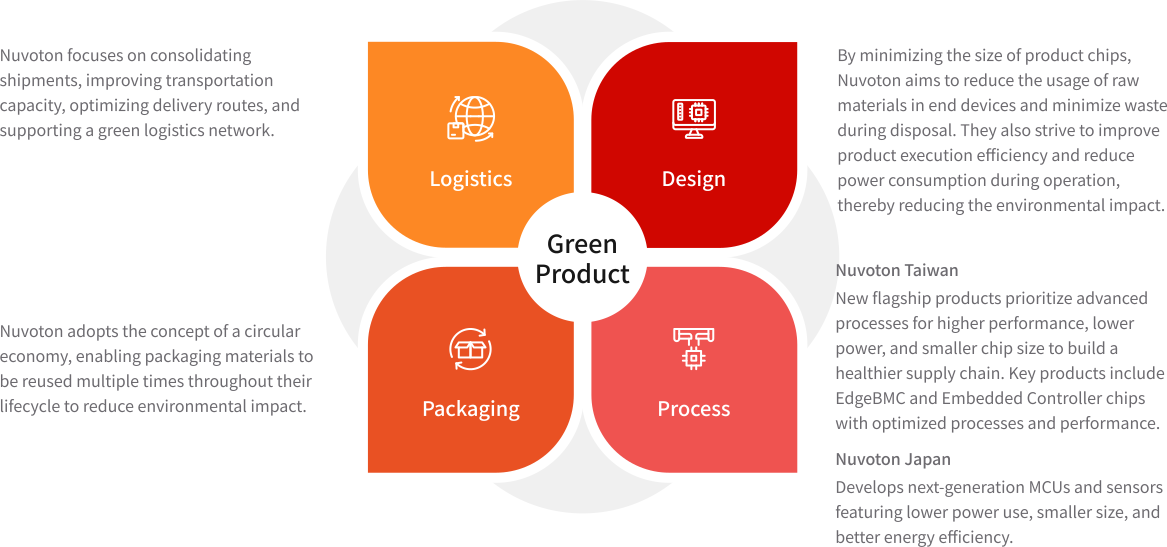
Centering on integrated circuits (ICs), Nuvoton's core product portfolio addresses extensive applications across diverse end markets and devices, significantly optimizing global environmental management and resource utilization. With our commitment to product responsibility, Nuvoton incorporates environmental sustainability considerations at chip design stage. Through continuous technological innovation, the Company promotes the development of low-power and miniaturized chips to enhance energy efficiency and mitigate overall environmental impact. In alignment with the principles and practices of green product development, Nuvoton has established six comprehensive management stages throughout the product lifecycle, thereby embedding environmentally friendly philosophies into both product development and operational processes.
| Stage | Principles and Actions | |
|---|---|---|
| Raw material selection | Nuvoton Taiwan | Nuvoton Taiwan adheres to the principles of a circular economy by prioritizing the use of reusable process raw materials and eco-friendly chemicals. By initiating process management and resource recycling mechanisms, inorganic sludge produced during manufacturing (such as CaF2) is reused, while sulfuric acid, hydrofluoric acid, isopropanol, and organic solvents are recycled as industrial-grade raw materials. Chemical containers are cleaned and reused or transformed into recycled materials |
| Nuvoton Japan | Nuvoton Japan has formulated a green procurement policy that prioritizes the selection of environmentally sustainable substances and practices when procuring components and materials. This policy delineates explicit standards, including the "selection of materials free from harmful substances" and "prioritization of suppliers adopting processes with minimal environmental impact." | |
| Design | Nuvoton Taiwan | Nuvoton Taiwan focuses on chip miniaturization to decrease raw material usage and waste generation in end devices while simultaneously enhancing product operational efficiency and minimizing power consumption, thereby lessening environmental impact |
| Nuvoton Japan | Nuvoton Japan implements rigorous green design principles from the outset of product development. Specific strategies include a focus on "chip miniaturization" and "power reduction" to minimize raw material requirements and energy consumption during product usage. From the design phase, there is a stringent avoidance of harmful substances, ensuring full compliance with international environmental regulations, such as the RoHS Directive, REACH Regulation, and WEEE Directive. Moreover, Nuvoton Japan has established proprietary "green product" standards, setting targets for each new product to more effectively diminish environmental impact compared to antecedent generations | |
| Manufacturing | Nuvoton Taiwan | Nuvoton Taiwan prioritizes the utilization of advanced manufacturing processes for its new flagship products to achieve superior computational performance, reduced energy consumption, smaller chip dimensions & packaging, and optimized circuit board space utilization, thereby fostering a healthier and more sustainable production supply chain. Representative offerings from the Cloud Computing Business Group include the EdgeBMC for edge computing management and Embedded Controllers for commercial notebook applications, both of which are meticulously optimized for chip processing and performance |
| Nuvoton Japan | Nuvoton Japan pursues clean and efficient manufacturing processes, with internal environmental policies centered on the effective utilization of resources and the prevention of pollution. Specific initiatives include promoting resource-circular manufacturing practices through the 3Rs (Reduce, Reuse, Recycle). Through diligent management of wastewater, emissions, and solid waste, the environmental impact of manufacturing facilities is substantially reduced, while energy management is strengthened with the integration of energy-efficient equipment and process optimization to lower the carbon footprint | |
| Packaging and transportation | Nuvoton Taiwan | Nuvoton Taiwan adopts the principles of a circular economy in packaging design, enabling packaging materials to be reused multiple times throughout their lifecycle, thereby minimizing environmental impacts. Efforts are concentrated on consolidating shipments and enhancing freight capacities |
| Nuvoton Japan | Nuvoton Japan actively seeks to mitigate the environmental impact of packaging materials and logistics during product shipments. In the realm of packaging, the Company follows circular economy principles to diminish the reliance on disposable materials. In logistics, the focus on optimizing transportation efficiency aims to reduce fuel consumption and CO2 emissions significantly | |
| Usage | While semiconductor products do not emit pollutants during operation, their power consumption remains directly associated with environmental considerations. Consequently, Nuvoton is committed to offering "energy-efficient products," seamlessly integrating eco-friendly attributes into product specifications | |
| Final disposal | The Company adopts a proactive stance against the use of harmful substances, incorporating considerations for safe and convenient disposal and recycling from the design phase onward. Furthermore, Nuvoton adheres to applicable electronic waste regulations and international standards, such as the WEEE Directive, consistently managing electronic waste in a responsible and sustainable manner | |
Product Carbon Footprint
Considering the environmental impact associated with products throughout their entire lifecycle, Nuvoton integrates carbon footprint management into its sustainable product strategy. Through systematic inventory and energy and resource consumption analysis during the design, manufacturing, and utilization phases, Nuvoton is committed to continuously optimizing product designs to mitigate environmental impact. From the inception of product development, the principles of green design are incorporated, encompassing careful selection of raw materials, stringent control of emissions during manufacturing processes, and the advancement of energy-efficient products. This approach facilitates the progressive reduction of energy consumption and related emissions during both the production and usage phases, thereby advocating for carbon reduction at the source.
In 2024, Nuvoton Taiwan successfully completed the carbon footprint audit for its wafer products in accordance with the ISO 14067:2018 standard, subsequently obtaining third-party verification. This initiative enables the Company to identify critical stages in the product lifecycle that possess potential for carbon reduction. Since 2025, Nuvoton Japan has performed a comprehensive carbon footprint audit for its product offerings, systematically managing carbonemissions throughout the entire lifecycle of major products, with a target to achieve ISO 14067:2018 third-party certification by 2026.
Nuvoton Japan has established an internal environmental sustainability task force, collaborating closely with the Taiwan headquarters to develop a robust product carbon footprint auditing framework. This framework employs a methodology of systematically gathering emissions data from suppliers related to each phase of wafer processing and packaging, enabling the quantification of differences in carbon footprints between new and legacy product generations. Internal audits follow the guidelines set forth in ISO 14067 and integrate the life cycle assessment (LCA) methodologies outlined in ISO 14040 and ISO 14044.
By 2026, Nuvoton will complete a comprehensive assessment of energy consumption and greenhouse gas emissions associated with our primary product, semiconductor integrated circuits (ICs) . This evaluation spans from raw material procurement and manufacturing to packaging and logistics, establishing a solid foundation for pursuing ISO 14067 certification. Additionally, the Company will extend educational training on carbon footprint auditing to relevant departments and establish a cohesive communication framework with Nuvoton Taiwan to facilitate the development of a comprehensive emission data management system.
Nuvoton's Green Products
| Benefit Type | Product Type | Product Name | Benefit |
|---|---|---|---|
| Reduced power consumption | Smart toy chip | N589S080 | Power consumption has been reduced by 25% compared to previous models |
| Microcontroller | NuMicro® M2L31 chips for low-power, high-performance microcontroller | Full-speed operating power has been reduced by 40% compared to the previous generation | |
| Digital temperature sensor integrated circuits (ICs) | NCT7738/7739 Temperature sensor chips | Power consumption has been reduced by 50% compared to previous models | |
| TMOS | KDSMKAB077NL: Designed for lithium battery protection | Compared to previous models, continuous operating power has been reduced from 62.50 mW to 31.25 mW, achieving annual electricity savings1 of approximately 2.42 MJ | |
| Battery management integrated circuits | KA49701A: Industrial BMIC (designed for the market of electric bicycles in China, as well as data centers in Japan and Taiwan) | Compared to previous models, continuous operating power has been reduced from 226 mW to 17.6 mW, achieving energy savings2 of 80% and annual electricity savings of approximately 15.81 MJ | |
| KA49702A: Industrial BMIC (designed for the market of electric bicycles in China, as well as data centers in Japan and Taiwan) | Compared to previous models, continuous operating power has been reduced from 226 mW to 17.6 mW, achieving energy savings3 of 80% and annual electricity saving of 15.81 MJ | ||
| Motor driver | KA443700A: A single-phase motor pre-driver compatible with 48V power sources (Applicable to cooling fans for servers, data centers, industrial equipment, and factory automation systems) | Compared to previous models, continuous operating power has been reduced from 624 mW to 288 mW, achieving annual electricity savings4 of approximately 25.40 MJ | |
| Microcontroller | Automotive system control microcomputer MN103LFEDWUB | Compared to previous models, power consumption during 2 hours of daily operation has been reduced from 330 mW to 144 mW, achieving annual energy savings5 of approximately 1.21 MJ | |
| Electric window ECU KM1M4BF66G | Compared to previous models, power consumption during 2 hours of daily operation has been reduced from 425 mW to 225 mW, achieving annual electricity savings6 of approximately 1.30 MJ | ||
| DSP | KM2KSZ200UA: Designed for automotive AC control panels, motorcycle dashboards, vehiclemounted head-up displays, and fuel cell remote controllers (formerly GerdaZWEI). | Compared to previous models, power consumption during 2 hours of daily operation has been reduced from 2400 mW to 750 mW, achieving annual electricity savings7 of approximately 10.368 MJ | |
| Saved chip size | Microcontrollers | Low-power, high-performance microcontroller NuMicro® M2L31 | The chip size has been reduced by more than 30% compared to the previous generation product |
| Digital voice recording chips | ISD3810 ChipCorder | The chip size has been reduced by 49% compared to the previous generation product | |
| Audio controllers | NSC128L42 Audio controller | Serves as a single-chip solution that replaces the previous-generation chip and additional functions in customer applications | |
| Smart toy chip | N589S080 Smart toy chip | Compared to the previous-generation chip, chip size has been reduced by 10%, while the size of core components has been reduced by 38% | |
| Edge computing management control chip | EdgeBMC | By adopting a more efficient chip packaging design, the package area has been reduced by 67% compared to the previous generation, thereby reducing silicon material requirements during chip manufacturing and saving PCB material and space in end-system applications | |
| Embedded controllers (EC) | Embedded controller NPCK398, specifically designed for mobile applications | The chip area has been reduced by more than 10% compared with the previous generation NPCK397 | |
| TMOS | Lithium Battery Protection IC KDSMKAB077NL | The chip size has been reduced by 49% compared to the previous generation | |
| Battery management integrated circuits | KA49702A (engineered for the electric bicycle market in China, as well as data centers in Japan and Taiwan) | The chip area has been reduced by 42% compared to the previous generation | |
| KA49701A (engineered for the electric bicycle market in China, as well as data centers in Japan and Taiwan) | The chip area has been reduced by 50% compared to the previous generation | ||
| Microcontrollers | Automotive system control microcomputer MN103LFEDWUB | The chip area has been reduced by 33% compared to the previous generation | |
| Electric window ECU KM1M4BF66G | The chip area has been reduced by 21% compared to the previous generation | ||
| Analog pre-drivers | Single-Phase Motor Pre-Driver KA443700A, compatible with 48V power sources (intended for cooling fans within servers, data centers, industrial equipment, and factory automation systems) | The chip area has been reduced by 30% compared to the previous generation | |
| Three-Phase Sensor-less Pre-Driver KN444900A (designed for 48V/1U server fans). | The chip area has been reduced by 9% compared to the previous generation | ||
| Digital signal processors | KM2KSD400UA (designed for automotive instrument panels and head-up displays) | The chip area has been reduced by 6% compared to the previous generation | |
| KM2KSZ200UA (applicable in automotive AC control panels, motorcycle dashboards, vehiclemounted head-up displays, and fuel cell remote controllers such as the Gerda-4UL) | The chip area has been reduced by 55% compared to the previous generation | ||
| IC cards | Security microcontroller for IC cards KM67S3B21T1 | The chip area has been reduced by 36% compared to the previous generation. | |
| Increased operational efficiency | Brushless motor control ICs | Motor driver IC brushless DC motor | Brushless DC motors are highly efficient, contributing to energy savings. Due to the high degree of design freedom, brushless DC motors are used in various markets and come with multiple voltage, speed, and load options |
| Microcontrollers | 8bit KM101 MCU | A microcontroller series equipped with an 8-bit proprietary central processing unit (CPU), recognized for its low power consumption, high code efficiency, and superior performance, thereby delivering capabilities that are comparable to those of 16-bit microcontrollers offered by competing manufacturers | |
| Microcontrollers | Arm® Cortex®-M7 MCU (KM1M7 series) | KM1M7 series is a 32-bit flash memory microcontroller equipped with Arm® Cortex®-M7. It features high processing capability and low power consumption, with high-performance PWM, high-speed, high-precision AD converter, and feedback control auxiliary functions suitable for motor control/digital power control applications, making it an ideal choice for power electronic control | |
| Laptops | NCT9640Y | Existing products are introduced into different market sectors to explore their inherent value and save IC development costs | |
| Servers | TF5103Y |
1 Assuming continuous operation for 24 hours with a power reduction of 31.25 mW per unit. By the estimated total sales volume of approximately 113,988,000 units over three years, the projected annual electricity savings can be calculated.
2 Assuming continuous operation for 24 hours, with a power reduction of 208.4 mW per unit. By the estimated total sales volume of approximately 26,178,000 units over five years, the projected annual electricity savings can be calculated.
3 Assuming continuous operation for 24 hours, with a power redcution of 208.4 mW per unit. By the estimated total sales volume of approximately 19,512,000 units over five years, the projected annual electricity savings can be calculated.
4 Assuming continuous operation for 24 hours, with a power reduction of 336 mW per unit. By the estimated total sales volume of approximately 38,700,000 units over five years, the projected annual electricity savings can be calculated.
5 Assuming continuous operation for 2 hours per day, with a power reduction of 186 mW per unit. By the estimated cumulative sales volume of approximately 1,118,000 units over five years, the annual electricity savings can be calculated.
6 Assuming continuous operation for 2 hours per day, with a power reduction of 200 mW per unit. By the estimated cumulative sales volume of approximately 11,330,000 units over five years, the annual electricity savings can be calculated.
7 Assuming continuous operation for 2 hours per day, with a power reduction of 1650 mW per unit. By the estimated cumulative sales volume of approximately 10,156,000 units over five years, the annual electricity savings can be calculated.
Nuvoton is dedicated to the continuous innovation and optimization of its product offerings. The next-generation microcontrollers, distinguished by their low power consumption, facilitate the development of more compact and lightweight products, thereby contributing positively to a wide array of applications, including medical devices, Internet of Things (IoT) devices, and smart city solutions. The introduction of these products not only enhances operational efficiency and performance but also provides increased convenience and accessibility to society. Nuvoton's products are extensively utilized across various sectors related to energy conservation and sustainability, including automotive applications (such as autonomous driving systems, power management systems, charging stations, and batteries), consumer electronics (encompassing household appliances and smart home devices), industrial control (covering environmental monitoring sensors and energy management), and safety management, thereby driving improvements in energy efficiency across relevant product and service markets.
Nuvoton will leverage its expertise in server and personal computer applications, actively pursuing advancements in cloud computing, edge computing, and endpoint computing domains. The Company will focus on the development of high-efficiency, energy-saving computer chip products that comply with contemporary safety regulations and incorporate artificial intelligence functionalities. Concurrently, Nuvoton will continue to enhance its offerings in TMOS, RF-GaN, Power-GaN, battery management chips, human-machine interfaces (HMIs), motor drivers, microcontrollers, Time-of-Flight (ToF) sensors, image sensors, and laser diodes (LDs), thereby launching new products distinguished by their market-leading specifications and versatility for a multitude of application domains.